
Lessons:

I-8 Jaune Quick-To-See Smith
Trade Canoe to the North Pole
Overview
- Discuss Canoe Trade: The Surrounded by Juane Quick-to-See Smith.
- Learn about mixed media and line weight.
- Create a story transport.
Reflection
- Who lives in the house that you created?
- What colors and objects did you add to describe mood of the house?
- What is the title of your artwork?
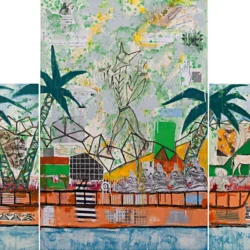
Trade Canoe to the North Pole by Juana Quick-to-See Smith, 2017, Oil, acrylic, paper, newspaper, and fabric on canvas, three panels: 60 × 160 in. (152.4 × 406.4 cm), OZ Art NWA, Bentonville, Arkansas. © Jaune Quick-to-See Smith, image credit: United States Artists, photo by Neal Ambrose-Smith.
Discussion Presentation
Discussion Questions
What does the idea Trade Canoe mean to you?
Smith is asking: What are we trading away for these things? The artist is storytelling the history of how Native American culture has been turned into souvenirs and sold.
What types of materials do you see, besides paint?
This artwork isn’t just flat paint. Jaune uses mixed media, which means she mixes things together like newspaper clippings, photos, and drips of paint. It’s a collage that has layers of history, literally.
What drawing grabs your attention?
There are a lot of images piled high. The line weight (thin or think) and style of line (pencil or marker or paint) can add variety to a drawing or painting that uses a lot of line drawings.
Biography
- Jaune Quick-to-See Smith (zhawn kwihk•too•see smith) was an American artist, enrolled in the Salish and Kootenai Nation, from Montana.
- She called herself a “cultural arts worker,” because she created, taught, curated, wrote, and organized art for the Native community.
- Her art is about Native history and our environment.
- Her “Trade Canoe” series is one of her most famous projects about Native Americans.
- She was an environmentalist and her art spoke of her concern of climate change and environmental damage.






Project
Materials
- sketch paper
- drawing pencil
- 9×12 white paper
- conical markers
- scissors
- tape (optional)
- How to Draw a Transport handout
Warm Up & Brainstorm
- 3-minute brainstorm: discuss ideas of what tells their story: memories, places, foods, etc.
Project Directions
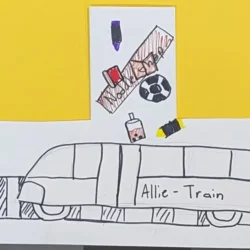
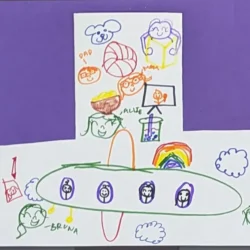
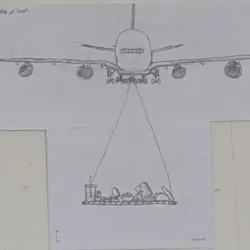
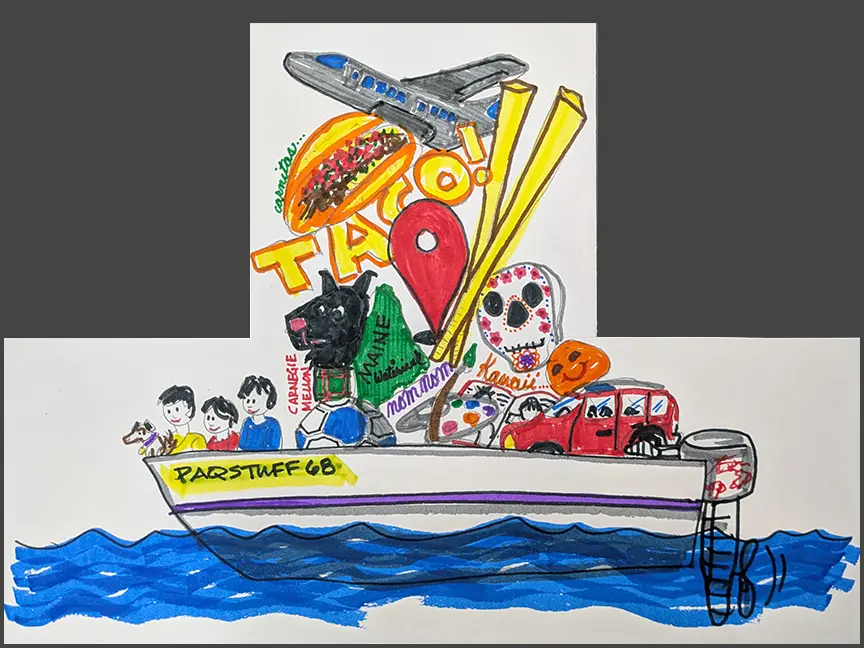
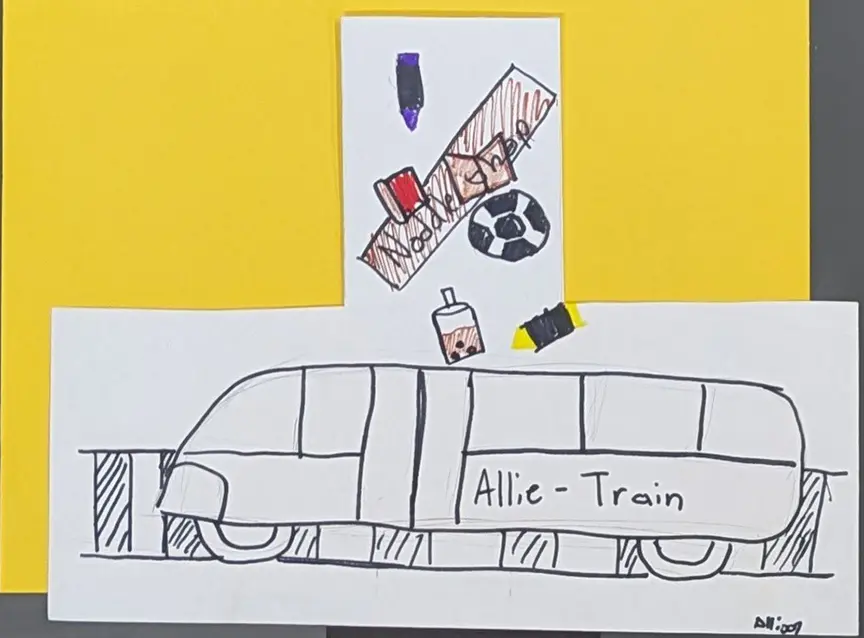
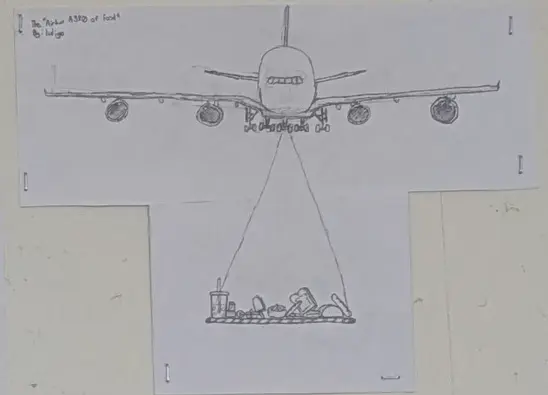
Story Transport
1. Make an upside-down T-paper shape.
Halfway up and from the side edge, cut a horizontal line about 3 inches long. Do the same on the opposite side. Then fold the edges under, to make the upside-down T.
2. Create a transport.
Decide if the wide part of the T is at the top of bottom. Draw the transportation, using How to Draw Transportation handout.
3. Pile up your story.
Draw the ideas, places, people, foods, things that are important to you. Introduce mixed media by having some visual be pencil shaded and others be marker!
4. Add color.
Use markers to color in or outline your drawings. If you have other materials available, explore a more mixed media piece.
5. Give art a title.
Pre-Lesson Preparation
- No prep required.
Day of Lesson Setup
- Demo creating T-shaped project paper. Vertical column should be ~3 in. (1/3 paper width) or wider.
- Tip: before the activity, make your own Story Transport and share as an example, instead of the 3-minute brainstorm.
- Tip: bring in print media images for kids to cut out and make it a mixed media art piece.
- Emphasize: what they add should not only be material objects. It can be foods, ideas, places, memories to describe their story.
- Lengthen activity time: pre-prep project paper, make project paper (Step 1) before the art lesson.